Wednesday, February 3, 2016

Bias from her perspective


This article was published was published in the HINDU on 2nd february 2016 but it was truncated and its import got diluted . The link is                  http://www.thehindu.com/opinion/open-page/open-page-bias-from-her-perspective/article8180006.ece   

A little Girl’s Reflections on her School Books


Why can’t I be the judge in the play? Because I am a girl! Well, this is what my class 3 NCERT Hindi text book says!! In that chapter which contains the play on the parable in which the monkey is the judge between two cats fighting for a bread, the stage directions so clearly say – ‘7-8 baras ka ladka bandar ban sakta hai aur 5-6 baras ki ladkiyaan billi ban sakti hain.’ (a boy of 7-8 years of age can become the monkey and girls of 5-6 years can play the parts of the cats). Even the dress has been so precisely prescribed for the boy-monkey and the quarreling cats. And, at the end of the play, how I hate when we two girls, acting the cats, chant -“aapas mein jhagdaa kar baithin, buddhi apni khoti…” (we fought among ourselves as our minds are weak). As if it’s only girls who fight for small things!  Doesn’t my brother, many a times, fight with me for that last piece of pizza?
            Yes, I am only a 10 year old small girl and might not be so knowledgeable but, even then, some of it is so obviously unfair. Just look at the picture of the three kids playing basketball, in the chapter ‘Teamwork’ in my class5 English book. It shows the lone girl’s feet on the ground and the ball beyond her reach, while the two boys are shown high up in the air putting the ball in the basket. I really feel bad because I can beat any boy in my class in racing, football and basketball.
I love playing all sorts of outdoor games and my favourite game is cricket. In the illustrations in my text books through all my classes, however, I have seen only boys playing cricket while the girls have dolls in their hands. How much have I always disliked playing with dolls!!
            My aunt is a doctor but I have yet to see a picture of a lady doctor in a book. In that picture of a doctor administering vaccine to a child, we see a male doctor, a nurse and a queue of mothers carrying their children. My experience is so different. I love to go along with my Papa to the doctor and he makes me feel so brave that I don’t even fear the injections. Oh! How I pity those boys who are so frightened of injections.
            It’s not only about the doctors. If you see my EVS book you will see that the pictures in the chapter ‘Organizations that help us’, depict only men doing all the important jobs. There are five different pictures of various professionals- the police, doctor, army personnel, workers in a post office- and none of them has a woman. Even in my younger brother’s book who is in class 2, there are pictures of 12 professionals in the chapter, ‘We Need Them’, and none of them is of a woman. And you know what? The only picture of woman in his book is in the part ‘People who entertain us’ and, that is of her as a dancer. Even in my book the chapter ‘Our Heritage’ has women in all its pictures- the pictures being of various dances in our country. Hey! Everybody, even a kid, knows that women are performing duties in every field. My father showed me in the newspaper the other day that they were the lady scientists who made the Indian Mars mission so successful.
            I have heard so much of a lady Arunima Sinha who reached the top of Mount Everest even though she had lost her foot in an incident; but I can’t understand why my text book has the picture of only men as mountaineers. Don’t these writers of the text books read newspapers?
            And it’s not only about the outside world. Even the description at some places of the household chores make me think them to be so odd! Just sample this from a chapter ‘Drop by Drop’ in my NCERT EVS book - ‘His mother and sister have to walk a longer distance to fetch water… While walking on the hot sand their feet burn and blisters just cannot be avoided. When the train carrying water comes they are very happy. Madho’s father goes to fetch water in his camel-cart’.  Is it all right that while the women travel on foot, the man does it on a cart? To my little girl’s mind it somehow doesn’t feel all that nice.
            I don’t know if I am a bit weird and that all of the above seems strange to me only or, something’s really amiss in our books. If it’s so, somebody please do something as what we learn in our childhood stays with us forever and makes us what we are in our adulthood. Why do they think that it’s only boys who can jump high, love cricket and football or, do jobs like flying a plane or working in a steel plant? I hope people writing the books start believing that even boys weep and the girls love to play boisterously.

                                                Dr  Skand Shukla
(An Officer of the Provincial Education Services and was a visiting Fellow to the Arizona State University, U.S.A)


Thursday, December 17, 2015

Musings on the Rooftops-

Musings on the Rooftops

How empty and lifeless are the rooftops of these high-rises! The huge water tanks and dish T.V. antennas are their only adornments. Children do not go there to play, neither does a young lady dry her long tresses sitting there in the warmth of the winter Sun, making some young boy smitten on some neighboring rooftop. Winters, on them, do not resonate with the laughter of ladies sitting together, creating designs on the wool with their knitting-needles while keeping a watch on the kids playing nearby. The young, from these rooftops, do not render the sky a riot of colours with their kites in that short spring season before the Sun turns fierce. Summer evenings do not see the drenching of the rooftop floor before the cots are laid down for the night’s sleep. And, no longer do children or lasses dance on the rooftops welcoming the splatter of the first showers as it soaks the world around with petrichor.
 It was so different when the towns hadn’t turned into megalopolises and, the houses did not resemble cells of a honeycomb. The roofs of the houses were as lively, open and, welcoming as the then life. The sound of chirping crickets, the waft of an old film song on radio from some distant roof and, the soft voices of a conversing couple or someone narrating stories to kids slowly faded away, as the gentle summer breeze, with a whiff of the sweet mild smell of a mango tree in bloom, lulled all to sleep. The warmth of the afternoon Sun in the winters brought all and sundry to their rooftops and it became a stage for varied activities- sun bath for the oil glistening torsos before the water- bath, indoor games or outdoor games with improvisations according to the size of the rooftops and, a snooze for the elderly.
Life, however, in these giant residential complexes in our asphalt jungles, is a bit different. Closeted with the four walls all the day long, it is amidst the monotonous whirr of the air-conditioners and intimacy with the communication gadgets that one goes to sleep. Isn’t the word ‘complex’ denoting these giant residential buildings so apt? This word– both as a noun and, as an adjective- signifies all the characteristics of these buildings aspiring to touch the clouds. In thinking thus, I am reminded of two great thinkers- Ruskin and Tagore. While Ruskin believed that our architecture is an expression of our life and character, Tagore wrote- ‘…walls leave their mark deep in the minds of men. They set up a principle of ‘divide and rule’ in our mental outlook, which begets in us a habit of securing all our conquests by fortifying them and separating them from one another…. It breeds in us a strong suspicion of whatever is beyond the barriers we have built, and everything has to fight hard for its entrance into our recognition’.  The openness, sharing in the griefs and happiness of others and, genuine joie de vivre  in our lives, a few decades back, seems to have been replaced by canned emotions and their digital expressions. Has our world view   been limited by the size of our open terraces and the time we get to spend on it? I wonder.

                                                                    (published in HT Lko - 15/12/2015 Link- http://paper.hindustantimes.com/epaper/iphone/homepage.aspx#_article33a44347-42e3-4f2d-8a82-2b77e82f27af/waarticle33a44347-42e3-4f2d-8a82-2b77e82f27af/33a44347-42e3-4f2d-8a82-2b77e82f27af/true
)


Sunday, October 18, 2015

Primary textbooks reinforce gender stereotypes

‘Why should boys have all the fun?’ – goes the tag line of a commercial. The text books of my primary level kids may well be asked this question. The Social Studies  class 4 book of my son, in its chapter ‘Seasons’, has five different pictures on seasons- each depicting a child enjoying itself, and not one is of a girl-child; the chapter, ‘Natural Resources’, has a picture of children enjoying themselves in a pond and, all of them are boys. It’s not only about play, but also about work. The pictures in the chapter ‘Organizations that help us’, depict only men doing all the important jobs. There are five different pictures of various professionals- the police, doctor, army personnel, workers in a post office- and none of them has a woman. Interestingly however, one chapter, ‘Our Heritage’ has women in all its pictures- the pictures being of various dances in our country. Similarly, the Class 2 book  of my younger son, Environmental Studies, has pictures of 12 professionals in the chapter, ‘We Need Them’, and none of them is of a woman while, again interestingly, in the same chapter, the sub section ‘People who entertain us’ has the only  picture of a woman and , it is of a dancer !
            The outdoors being for boys and girls both, is not the only issue regarding the subtle bias in gender representation in our children’s books. An example from the NCERT Hindi book of class 3 Rimjhim, shows how finely the dominating maleness is interwoven in the tone and tenor of the text and the image. The stage directions for  a skit of the famous parable of a monkey eating the whole bread being fought over by two cats are worded thus- ‘7-8 baras ka ladka bandar ban sakta hai aur 5-6 baras ki ladkiyaan billi ban sakti hain.’ (a boy of 7-8 years of age can become the monkey and girls of 5-6 years can play the parts of the cats). A dialogue by the monkey goes so- “roti kiski? Mai iska faisala karoonga. Chalo kachehry, mere peechhe peechhe aao.” (Whose bread? I will decide it. Come to the court, come behind me), followed by the directions-‘bandar dono se chheenkar roti apne haath mei lekar chalta hai, dono billiyaan peechhe-peechhe aati hain’ (The monkey snatches the bread from both of them and walks away with it while the two cats follow). The play ends with the words- “aapas mein jhagdaa kar baithin, buddhi apni khoti…” (we fought among ourselves as our minds are weak)

The stage directions specifying the gender of the actors for the role of the monkey and the cats sets the gendered tenor of the skit. The tone of the dialogues along with the illustration-  the monkey sitting on a pedestal as the cribbing cats literally look up to him for justice- underpin the notions of requirement of aggressive masculinity for decision making and, of females given to stupidly fighting over small things.
My experiences as a teacher-trainer are that people fail to realize the gendered undertones of a text/image in our books unless strongly hinted. This is because all of us have been brought up in the same gender-construct milieu. A text book shapes the belief system of the coming generations and, the content as above, only go on to reinforce, unknowingly, our impressionable minds with the gender stereotypes. A rethink is required on our definitions, language and concepts to create gender non-discriminatory knowledge for our children. For instance, physical stamina, thresholds of pain and, longevity can also be taken to be indicators of ‘strength’ along with its usual measurement in terms of running faster, jumping higher, etc., as  The Position Paper of the National Focus Group on Gender Issues in Education (NCERT), suggested almost a decade back. Incidentally, a picture of three children playing basketball, in NCERT’s class 5 English Book, shows the lone girl’s feet on the ground while the two boys are high up in the air.
It is important that the material presented before children is such which is empowering for girls in the sense of making them realize their potential, frees the boys from the bondage of stereotype male-hood of aggressiveness and curbing of emotions, and thus, raise a generation that is capable of contributing to the making of a just and compassionate society.http://paper.hindustantimes.com/epaper/viewer.aspx?noredirect=true 

Tuesday, June 30, 2015

For Allahabad to be a SMART city

For Allahabad to be a SMART city
(
Published in HT Special Supplement on its 18th anniversary )

Those pictures related to the various public services in a city in any primary school Civics text book have always been so fascinating. But, of course, the reality has always been so remote from them. Now, however, with the coming up of SMART city, we might experience our city as a picture-perfect one – one with tree-lined, wide, clean roads with orderly traffic; tidy offices, public conveniences (even for the differently abled) etc, etc.
The concept of a SMART city, in brief, is the use of information technology and electronics for the optimum management of a city’s resources and provision of the best services to the public.
Before embarking on how the technology can be used to turn our city of Allahabad SMART, it would be worthwhile to identify the big sores that are to be addressed. Some of them being- the roads sans pavements but with lots of cattle acting as speed breakers, non-existent clean and safe public transport system, public parks encroached as parking spaces or at worst turned into garbage dumping grounds, the biggest park i.e. the Company Bagh itself in need for oxygen with the depleting tree cover, pitiable condition of the government hospitals, poor sports facilities, and non- availability of public conveniences even for the able leave alone the handicapped. 
To make this city a nice place for living some essential features required are as follows.
 A traffic system which will make the flow of traffic non-polluting, swift, orderly and safe. It would require removing cattle from all the streets and lanes of the city and creating cattle sheds or piggeries outside the city limits. It would further require creating road conditions in which cyclists and pedestrians can use them confidently and safely. Lanes have been drawn on certain roads but are not followed for many reasons one of them being the encroachments for example by vegetable sellers as on the very busy Stanley Road. Instead of the polluting tempos a credible public transport system has to be put in place which apart from serving the city connects the nearby small towns.
A green and environmental friendly city in which polythene is a strict no-no and the trees like the neem and tamarind line the roads at regular intervals. This city which, when seen from a high building as the Indira Bhavan, looked so green a couple of decades back, looks like an alopecia patient who has become  bald in large ugly patches. Even the Company Garden that has become a playground to amateur tinkering planners can be simply afforested and left to its pristine self. Also, the hundreds of parks in various localities can be freed of encroachments and filth to become green and playgrounds and spaces for leisure for kids and senior citizens respectively.
All the electricity meters can be made into pre-paid ones to ensure non-pilferage. The big buildings, both governmental and private, and the street lights should have provision for automatic switching off lights when not in use or not required.
Clean toilets for the differently abled besides both the genders at every public place and all buildings and offices are a must. The fact is that even such places as the University, the Sangam Place or the Indira Bhawan housing many offices have very poor facilities for public conveniences. They are in fact public- inconveniences!!
Waste management is essential in any human setting. Instead of dumping it at places not much visited, it would be good if it is recycled or used as fuel in an energy conserving and environmentally friendly manner.
Public services like medical, policing and sports have to be ensured by the provision of human and material resources to the respective areas.
 To make the above possible, information technology has much to do. Wireless interconnected platforms can involve public in collaborative projects and real time decision making. For example, the City of Amsterdam has had projects to reduce traffic, save energy and improve public safety. It accepts proposals from the citizens for applications and developments that can be of use to the city. An example of a resident developed app is Mobypark, which allows owners of parking spaces to rent them out to people for a fee. The data generated from this app can then be used to determine parking demand and traffic flows in Amsterdam.

E-surveillance, e- monitoring, e-collaborative planning and e-records available in the public domain can thus go a great distance to create a city as our school book writers envisage.
---------------------------------------------------------------------------------------------------------


Thursday, June 11, 2015

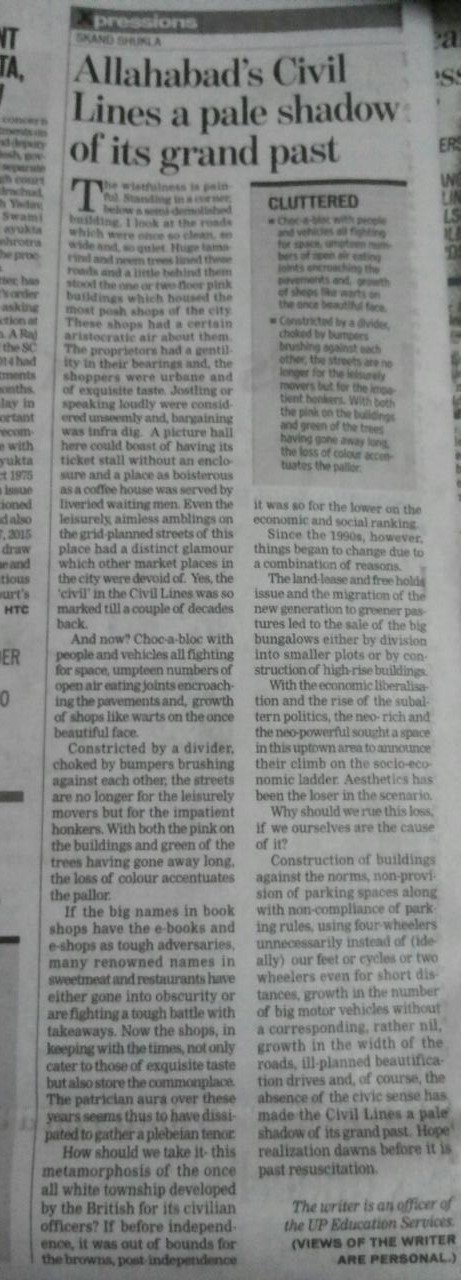
Allahabad Civil Lines a Pale shadow of its grand past

Published in HT All U.P. Editions- 12-6-15 link- http://paper.hindustantimes.com/epaper/viewer.aspx?noredirect=true

Civil Lines - From Patrician to Plebeian

The wistfulness is painful. Standing in a corner, below a semi-demolished building, I look at the roads which were once so clean, so wide and, so quiet. Huge tamarind and neem trees lined these roads and little behind them stood the one or two floor pink buildings which housed the most posh shops of the city. These shops had a certain aristocratic air about them. The proprietors had a gentility in their bearings and, the shoppers were urbane and of exquisite taste. Jostling or speaking loudly were considered unseemly and, bargaining was infra dig.  A picture hall here could boast of having its ticket stall without an enclosure and a place as boisterous as a coffee house was served by liveried waiting men. Even the leisurely, aimless amblings on the grid-planned streets of this place had a distinct glamour which other market places in the city were devoid of.  Yes, the ‘civil’ in the Civil Lines was so marked till a couple of decades back.
And now? Choc-a-block with people and vehicles all fighting for space, umpteen numbers of open air eating joints encroaching the pavements and,  growth of shops like warts on the once beautiful face. Constricted by a divider, choked by bumpers brushing against each other, the streets are no longer for the leisurely movers but for the impatient honkers. With both the pink on the buildings and green of the trees having gone away long, the loss of colour accentuates the pallor.  If the big names in book shops have the e-books and e-shops as tough adversaries, many renowned names in sweetmeat and restaurants have either gone into obscurity or fighting a tough battle with takeaways. Now the shops, in keeping with the times, not only cater to those of exquisite taste but also store the commonplace. The patrician aura over these years seems thus to have dissipated to gather a plebeian tenor.
How should we take it- this metamorphosis of the once all white township developed by the British for its civilian officers? If before independence it was out of bounds for the browns, post-independence it was so for the lower on the economic and social ranking.  Since the 90’s however things began to change due to a combination of reasons.  The land-lease and free holds issue and the migration of the new generation to greener pastures led to the sale of the big bungalows either by division into smaller plots or by construction of high rise buildings.  With the economic liberalization and the rise of the subaltern politics, the neo- rich and the neo-powerful sought a space in this uptown area to announce their climb on the socio-economic ladder. Aesthetics has been the loser in the scenario.
Why should we rue this loss, if we ourselves are the cause of it?  Construction of buildings against the norms, non-provision of parking spaces along with non-compliance of parking rules, using four wheelers unnecessarily instead of (ideally)  our feet or cycles or two wheelers even for short distances, growth in the number of big motor vehicles without a corresponding, rather nil, growth in the width of the roads, ill-planned beautification drives and, of course, the absence of the civic sense has made the Civil Lines a pale shadow of its grand past.  Hope the realization dawns before it is past resuscitation.
                                                    Skand Shukla


Saturday, November 22, 2014

Being stupid once again


Being stupid once again
published on our reunion day 21-11-14 HT Alld

Memory acts a juggler as it tosses up images, catches them for a fleeting moment to toss up as another replaces it. Teary eyed 4-5 years olds not letting go of our parents’ fingers, chaperoned to our seats gently, the first friendships and exchanges of rubbers and pencils, teachers whose memories are so vivid for a variety of reasons, kneel downs, canes of varying thicknesses, the goose bumps on the calls from the principal’s office, catching tadpoles in the tiffin boxes from the flooded field after the monsoon rains, throwing up paranthas and watching with glee the kites diving to catch them in their beaks… they just go on and on and render the intervening years redundant. There have, of course, been those  Wordsworthian moments in which we could say- ‘But oft, in lonely rooms, and 'mid the din/ Of towns and cities, I have owed to them/ In hours of weariness, sensations sweet …’, but, the feeling that 25 years have passed since      then makes it the more poignant. 
            Did we realize that day- the last day of our ISC examination when we wrote ISC BATCH 1989 and IIS (an acronym only the batch knows) on the street in front of the iconic Bhargava Book Shop and lit- it up to watch the flames jump up- that this crowd would be future civil servants, armed forces officers, doctors, engineers, management specialists…giving their best in serving our country and society? Were we aware that days of being stupid without giving a fig to the world were over? 
We - the St. Joseph’s College ISC 1989 batch – meet again, on the 25th year of our passing out of the hallowed edifice. With twinkles in the eyes we shall espy those steps and recollect the languorous winter lunch time spent sitting there while others played a game exclusive to this institution-- ‘steps’, look for the tree whose fruits were called ‘the monkey fruit’, talk about the taste of Roshan’s canteen, show to our spouses our classrooms whose desks bore the name of the then flames accompanied by  the mandatory symbol of a  heart pierced by an arrow, brag to the kids how disciplined we were and thus try to recreate those 12 years which seemed so long then but now so short that we all would love to lengthen them to eternity. For where else one can afford to be stupid than among old friends?


Monday, November 10, 2014

एहसास- published on the literary page of Daink Jagran 10-11-14

http://epaper.jagran.com/ePaperArticle/10-nov-2014-edition-Delhi-City-page_17-4581-4351-4.html


एहसास

निस्सीम फैला ऊसर और उस पर पसरी बैसाख की अंतहीन धूप। यह मेरे जनपद का सुदूर वह क्षेत्र था जहॉ से नगर को उसके विकास के लिए मिलती थी ईंट और, श्रमिक। उस कठिन स्थान पर हुयी थी मेरी तैनाती। मन में कितनी प्रसन्नता थी जब सरकारी विद्यालय मंे शिक्षिका की नौकरी मिली, कितना उत्साह! उत्साह मात्र नौकरी मिलने का नहीं बल्कि उस आत्मविश्वास का , उस आशावाद का जो युवावस्था को परिभाषित करता है।

विद्यालय शहर में मेरे निवास स्थान से लगभग 30 किलोमीटर दूर था। बस तथा टैम्पो यात्रा के बाद लगभग एक किलोमीटर की पदयात्रा कर वहाँ पहुचना होता था। बहुत कुछ करने की इच्छा थी और विश्वास था उन नकारात्मक स्थितियों को बदल देने की जो हम सुनते, पढ़ते रहते है। यह केवल अपने दायित्वों के बोध के कारण नहीं था वरन् मन में छोटे बच्चों के प्रति स्वाभाविक स्नेह के कारण भी था।

वास्तविक विद्यालयीय व्यवस्था और शिक्षा तन्त्र से मेरा प्रथम साक्षात्कार-  दो कक्षीय, चहारदिवारी विहीन भवन; कुछ दूर पर एक हैण्डपम्प और पास ही शौचालय, जिसके दरवाजों पर ताला जड़ा था। बुजुर्ग प्रधानाध्यापक ने मेरे अभिवादन का उत्तर दिया और एक कुर्सी पर बैठने का इशारा किया। आवाज सुनकर बगल के कक्ष से एक और अध्यापिका आ गयीं। परिचय हुआ तो मालूम चला कि प्रधानाध्यापक सेवा निवृत्त होने वाले है, और मेरी साथी अध्यापिका भी शहर से ही आती हैं जहाँ उनके पति सरकारी अधिकारी थे।

‘‘ चलो बहुत अच्छा हुआ कि तुम यहां आ गयी,’’ उन्होंने कहा, ‘‘ मैं तो सोच रही थी हेडमास्टर साहब के रिटायरमेन्ट के बाद कैसे चलेगा। इतना तो काम है- पंजिकायंे तैयार करना, ढे़र सारे व्ययों का हिसाब-किताब रखना, मध्याहन भोजन, यूनिफार्म, न जाने क्या क्या और दिक्कते? बाथरूम तक तो है नहीं’’, वो बोलती ही जा रही थी। ‘‘ बच्चे कितने है?,’’ मैने पूछा क्योंकि विभिन्न उम्र के मुश्किल से 10 बच्चे ही बाहर मैदान में दिख रहे थे। बताया गया कि है तो 100 बच्चे नामांकित परन्तु इन दिनों विवाह-लग्न और गेंहू कटाई का समय होने के कारण बहुत कम बच्चे विद्यालय आ रहे हैं।

मैने अपने चारो ओर देखा- चमक खोती, बेरंग होती सफेद दीवारें जिन पर कुछ आदर्श वाक्य लिखे थे। सचमुच, टैगोर का विवरण- ‘‘ बेयर व्हाइट वाल्स स्टेयरिंग लाइक आई-बाल्स ऑफ द डेड (मृतक की आँखों की तरह घूरती सूनी सफेद दीवारें)- कितना सटीक बैठता था। आज भी!

‘‘ असल में पढ़ने में इनका मन ही नहीं लगता’’, साथी अध्यापिका ने कहा। ‘‘ लाख समझाओं, पाठ समझ में ही नहीं आता, ‘‘प्रधानाध्यापक ने जोड़ा। मैने उड़ती सी नजर बाहर डाली। किचेन-शेड में मध्याहन भोजन की तैयारी प्रारम्भ हो रही थी। कुछ बच्चें वहीं ताक-झांक कर रहे थे।‘‘ कितने ही बच्चे होंगे जिनका दिन का प्रथम भोजन यही मध्याहन-भोजन होता होगा,’’ मैंने सोचा। मास्लो की आवश्यकता-पदानुक्रम का ख्याल न जाने क्यों अचानक आ गया।

विद्यालय का समय हो चला था। हम सब बाहर चले आये, प्रार्थना जो होनी थी। बच्चों की संख्या 40 के आस पास हो चली थी। विद्यालयीय परिधान में बच्चे आड़ी-तिरछी लगी बटनंे, हाथों में झोला (जिसमें किताबों के साथ किसी-किसी में थाली भी दिख रही थी) और कई उस गर्म मौसम में भी नंगे पैर पंक्तियों में खड़े थे।

प्रार्थना के बाद बच्चे दो कक्षा कक्षों में अपने आप चले गये। मेरे कक्षा-कक्ष में कक्षा 1 और 2 के कुल 15 बच्चे थे टाट-पट्टी पर बैठे हुये। ‘गुड-मार्निंग’ के समवेत स्वर ने मेरा स्वागत किया। अंग्रेजी में अभिवादन का अपना अलग ही प्रभाव होता है।  अंग्रेजी का उपयोग न जाने क्यों सुनने वाले को बोलने वाले में ज्ञान का आभास देने लगता है, मैने मन ही मन चुटकी ली। बच्चों की आँखों में मेरे प्रति कोई आकर्षण का भाव नहीं था, हाँ जिज्ञासा अवश्य दिख रही थी। मैने बोला- ‘‘तुम लोग मुझे जानते हो’’? कुछ ने ‘नहीं’ में गर्दन हिलायी, कुछ बस ताकते रहे और शेष अपने में मस्त थे। मैने उन्हें बताया कि मैं उनकी नयी अध्यापिका हूँ। बच्चों के परिचय से मैंने प्रारम्भ किया। उनमें अधिकतर लड़कियाँ थीं। भाइयों के बारे में पूछने पर मालूम हुआ कि कई उसी गाँव के प्राइवेट विद्यालयों में पढ़ते हैं। सौ प्रतिशत नामांकन का एक पक्ष यह भी है, मुझे मालूम चला। सभी बच्चे आस-पास के क्षेत्र के थे और लगभग सभी के माता-पिता मजदूरी करते थे अथवा गाँव में ही अपने छोटे-मोटे काम से अपनी जीविका चलाते थे।

    शिक्षा सत्र का अन्तिम पक्ष चल रहा था अतः मुझे लगता था कि कुछ नया तो पढ़ाना नहीं है बल्कि पूर्व में पढ़ाये गये पाठों की पुनरावृत्ति ही कराना है। पहले से सोची गयी रूप रेखा के अनुसार कार्य आरम्भ किया। परन्तु स्थिति अच्छी नहीं थी। अक्षर ज्ञान अति न्यून- पहचानने की ही समस्या थी, लेखन तो दूर की कौड़ी थी। मैं बच्चों के पास जाकर उनकी पुस्तकें और कॉपी देखने लगी। ऐसा नहीं था कि उन्हें वर्ष भर पढ़ाया ही नहीं गया था, क्योंकि अभ्यास पुस्तिकाओं तथा कापियों पर कुछ कार्य किये गये थे और उन्हें जांचा भी गया था। परन्तु सम्भवतः ऐसा इसलिए था कि शिक्षा अभियान के प्रयासों से इनमें से अधिकतर बच्चे अपने-अपने परिवारों की पहली पीढ़ी थे, जो शिक्षा की डेहरी पर कदम रखे थे। स्वाभाविक है कि घर पर इनका मार्गदर्शन करने वाला कोई नहीं होगा। माँ-बाप यदि थोड़ा बहुत पढ़े लिखे भी होंगे तो भी दिन भर की हाड़-तोड़ मेहनत के बाद यह संभव नहीं होगा कि वे यह देख सकें कि बच्चे कुछ पढ़ लिख रहे हैं या नहीं।

   बस्तों में बिना कवर चढ़ी पुस्तकें ( कुछ बोध के अभाव में, और कुछ अखबारी कागज के अभाव में ), मुड़ी-तुड़ी पन्नों वाली नोट बुक, खेलने के लिए गिट्टियाँ और कंचे, सस्ती पेन्सिलों ............... यही सब था। देखते-देखते उस प्यारी सी, छोटी से लड़की के पास पंहुची जो कक्षा में सबसे शान्त और थोड़ा अलग सी बैठी थी- एक झोले में ठीक से रखी पुस्तकें और एक पुरानी डायरी, जिसे कॉपी के रूप में प्रयोग किया जा रहा था। अरे वाह! इसमे तो उसने ढे़रों चित्र बना रखे थे। चित्र, जो यह बताने के लिए बहुत थे कि उसमें चित्रकारी की विशेष प्रतिभा थी। पूछने पर बताया कि उसके पिता कुम्हार हैं और माँ बरतनों पर चित्रकारी करती है और, यह भी कि, उसे भी चित्र बनाना अच्छा लगता है। "तुम इतनी छोटी हो, इतने सुन्दर चित्र कैसे बना लेती हो "?  मेरे प्रशंसा-सिक्त प्रश्न पर उसने बाल सुलभ शर्म के साथ प्यारी सी मुस्कान दी, आँखों में आ रहे अपने बालों को हाथ से पीछे कर अवधी में बोली- " जब नाय आवत तो हमार अम्मा अंगुरी पकिड़ के बनवावथीं "। 

           मैं चित्रों को ध्यान से देख रही थी- नदी पहाड़ युक्त सीनरी, पशु-पक्षी, चाक पर कुम्हार, डाक्टर... मैने पूछा- ‘अरे! टीचर का तुमने कोई चित्र नहीं बनाया?’ उसने ‘नहीं ’ में गर्दन हिलाई। आखिर क्यों, मैंने पूछा, ‘‘ क्या तुम्हें अध्यापक अच्छे नहीं लगते?’’ उसने फिर से ‘नहीं’ में गर्दन हिलाई। ‘‘क्यों नहीं अच्छे लगते? मैंने आश्चर्य से मुस्कुराते हुए पूछा। और वो- जैसे बरस पड़ी- ‘‘ काहे कि, मैडम जी तो पियार करतिन नाहीं। छूबौ नाहीं करतिन। एक दिन दौड़त-दौड़त हम गिर ग रहे, खून निकलत रहा तो दूरै से कहत रहिन- ‘उठाओ उठाओ’। एकौ पग नाहीं बढ़िन। डाक्टर मुला पियार से हाथ पकिड़ के चुप कराइन, जरकौ दर्द नाहिं भा दवा लगाइन...’’ वो बोलती जा रही थी और सभी बच्चे हम दोनों को ध्यान से  देख रहे थे. स्नेहिल स्पर्श का महत्व जो बड़े-बड़े व्याख्यान नहीं स्पष्ट कर सके थे वो मेरे अन्दर तक पैठता जा रहा था. बचपन की स्मृतियों में सम्मिलित हाथ पकड़ कर अक्षर लिखना सिखाने वाली , अच्छा लिखने पर गाल छूकर शाबासी देने वाली और खराब लिखने पर प्यार भरी डांट पिलाने वाली टीचर का चित्र आँखों के सामने आ गया. ‘चाइल्ड-सेन्ट्रिक’,‘ चाइल्ड-फ्रेन्डली’ जैसे शब्द हवा में तैर रहे थे पर ‘चाइल्ड- लविंग’ कहीं दिख नहीं रहा था ! और मेरे मन में, बार-बार यह प्रश्न आ रहा था कि, कहीं ऐसा  तो नहीं कि, इन विद्यालयों में शिक्षक और विद्यार्थियों के बीच सामाजिक-आर्थिक अन्तर हमें ‘ह्यूमेन’, यानी इस सोपान में अपने से नीचे के प्रति दयावान और ‘पेट्रन’, होने का भाव तो ले आने कि अनुमति देता है परन्तु, ’अफेक्शनेट’ या स्नेहमयी होने के पहले ही ठिठक जाता है ?
------------------------------&&&&&&&&&&&&&&&&&&&&----------------------------

स्कन्द शुक्ल
 दैनिक जागरण के साहित्य पृष्ठ 'पुनर्नवा' पर
१० नवम्बर २०१४ को प्रकाशित ।